City Attractions
Kamphang Phet Historical Park
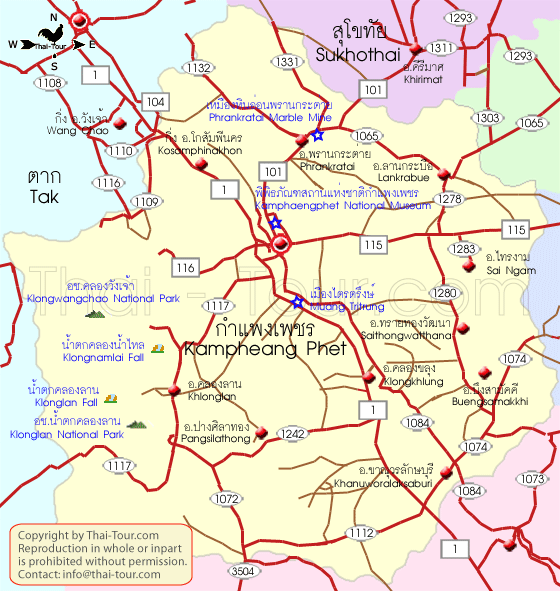
Major features in the Kamphang Phet Historical Park include archaeological remains of ancient sites such as Mueang Chakangrao to the east of the Ping River, Mueang Nakhon Chum to the west and Mueang Trai Trueng some 18 kilometres from the town to the southwest. Services from the Tourist Centre are available, the centre itself being located some 5 kilometres from town on the Kamphaeng Phet-Phran Kratai route.
Chakangrao, the ancient Kamphaeng Phet town, had the same town planning concept as the old Sukhothai and Si Satchanalai, with separate zones for religious sites both within and outside of town limits. Structures are usually large and made of laterite. Religious sites on the west bank of the Ping River at Nakhon Chum are built of bricks and of smaller
Remains of the ancient sites within the city walls are as follows:
City Walls and Old Fortifications mark the boundary of the rectangular town area, measuring 300-700 metre wide and 2,200 metre long.
Wat Phra Kaeo
 Wat Phra Kaeo is a large royal temple in town centre near a site believed to have been a palace. The temple itself was used on important city events and had no monks in residence. Major features include the principal Chedi with lion-adorned base and a round Chedi with elephant-adorned base. There are also other Chedis of different bases and remains of several chapels. Its boundary is marked off by laterite walls.
Second in size to Wat Phra Kaeo is Wat Phra That. Here the principal Chedi is built of mixture of laterite and bricks with a 15-metre wide square base. The style is of Kamphaeng Phet architecture.
Sa Mon is the site of the palace located to the north of Wat Phra Kaeo with a square earthen wall almost touching the northern city wall. Surrounded the walls on three sides are moats with a pond in the middle. There are no standing structures remaining today.
Wat Phra Non
 Wat Phra Non is fenced in by laterite walls on four sides. At the front of the temple are a square-shaped pond, bathrooms and an ancient floating pavilion which is supported by a large laterite column. The entire column was cut out in one single piece from its source and measures 1.1 meters on each side and 6.4 meters in height, the largest such stone in the country. A lion sculpture and Sema stones (boundary stones) can still be discerned. The large Vihan which once housed the Reclining Buddha has crumbled entirely.
Wat Phra Si Iriyabot
 Wat Phra Si Iriyabot is located to the north of Wat Phra Non and have similar pond and bathroom facilities as its neighbour. Walls on the four sides are of laterite materials with an entrance also made of laterite. A Mondop structure houses Buddha statues in four postures-walking, sitting, standing and reclining in the Sukhothai artistic style. Today only the statue in the standing posture still remains.
Wat Phra Sing
 Wat Phra Sing is believed to have been constructed during both the Sukhothai and Ayutthaya periods. With laterite walls, it has a square-shaped principal Chedi with arches on four sides. In front of the Ubosot are ornamental lion and Naga figurines.
Wat Chang Rop
 Wat Chang Rop is a large temple situated on a high hill. Its main chedi of Ceylonese style is in the middle of the yard but its top part is broken down. The base is adorned with 68 half-elephants between which are Bhoti-shaped designs. There are also traces of demon and female dancers figures remaining.Apart from these temples, there are also several ancient sites on the east bank of the Ping River, including Wat Arwat Yai, Wat Kalothai and Phra Ruang Road.
Mueang Nakhon Chum is an ancient town on the west bank of the Ping River. Its 2-3 metre-high earthen walls run along the waterway. It is in this area that the famous religious tablets of Kamphaeng Phet have been discovered. Within the city walls are a couple of ancient sites such as the Kamphaeng Pom Thung Sethi located on Phahonyothin Road just before entering the town. It is part of the laterite fortifications 83 metres long and 6 metres tall.
Wat Phra Borom That is a temple situated in the centre of Mueang Nakhon Chum featuring a Burmese-style Chedi. To the south is an Ubosot housing several Sukhothai- and Ayutthaya-style bronze Buddha statues. The Chedi itself is believed to originally have been a Sukhothai-type structure, its style having been altered during a restoration work financed by a wealthy Burmese about a century ago.
Another ancient town is Mueang Trai Trueng. It was built by King Chaisiri of Chiang Rai who fled invading enemy in 1542 B.E. (circa 999). Today most of the structures are in disrepair with only ruins of Chedis and ramparts. The town is about 18 kilometres from Kamphaeng Phet on the Kamphaeng Phet-Khlong Lan road.
Talat Kluai Khai
This market is on the Kamphaeng Phet-Nakhon Sawan highway at Km.343. Scores of roadside stalls display and sell both raw and ripe Kluai Khai (a type of bananas).
The Kamphang Phet National Museum
The Kamphang Phet National Museum, located on Pindamri Road in Mueang district, houses ancient objects and other antique arts articles from various eras found in the provincial town. These include sculptured and earthen designs, heads of Buddha statues, traditional celadon products, sculptures of demons and celestial and human beings used to decorate Chedi bases or Vihans. It is open Wednesday-Sunday from 9.00 a.m.-4.00 p.m. More information at Tel: 0 5571 1570.
The Kamphang Phet Province Museum
The Kamphang Phet Province Museum nearby is made up of groups of Central Region applied architectural style structures. There are exhibitions on the local history with replicas of the city, lifestyle and urban and hilltribal customs and traditions. It also displays the development of Kamphaeng Phet votive tablets and other resources. The museum is open daily. For more information, call 0 5572 2341.
Klong Lan
Khlong Lan National Park
The Khlong Lan National Park covers an area of some 300 square kilometres over mountain ranges to the west of the province. The highest peak is about 1,400 metres. Of mainly virgin jungles, it is the source of several streams which flow into the Ping River.
The park headquarters is near the Khlong Lan waterfall about 60 kilometres from town on the route to Khlong Lan district (highway no.1117). Attractions within the park include the 95-metre high Khlong Lan Fall with scenic surroundings, and the Khlong Nam Lai Fall, a 9-level cascade and located off Highway no.1117 at Km. 35 and 10 kilometres further on). The Kaeng Ko Roi (off Highway No.1117 at Pong Nam Ron intersection) is a group of rock formations jutting out of the stream looking somewhat like all islands. Visitors can camp overnight within the park.
Mae Wong National Park
The Mae Wong National Park forms the border between Kamphaeng Phet and Nakhon Sawan and covers an area of about 894 square kilometres. Most of the land is rich in various types of plants. Along the Khlong Lan -Umphang route passing through the park's area, which leads up to the mountains, are several viewing points between Kms. 81 to 115. At Km. 102 is a beautiful road-side waterfall. Other falls within the park include the Mae Krasa, Mae Liwa and others. To visit these attractions tourists need to go on foot and overnight in the jungle.
The Mae Wong National Park forms the border between Kamphaeng Phet and Nakhon Sawan and covers an area of about 894 square kilometres. Most of the land is rich in various types of plants. Along the Khlong Lan -Umphang route passing through the park's area, which leads up to the mountains, are several viewing points between Kms. 81 to 115. At Km. 102 is a beautiful road-side waterfall. Other falls within the park include the Mae Krasa, Mae Liwa and others. To visit these attractions tourists need to go on foot and overnight in the jungle.
by : thai-tour.com